
When Do You Need a Gas Appliance Safety Record?

A gas appliance safety record is more than a document to file away. For landlords, it is evidence that gas appliances, flues and related pipework have been checked by a Gas Safe registered engineer and are safe for tenants to use. Missing, expired or incomplete records can create legal problems, delay a tenancy and, more seriously, put people at risk.
For homeowners, an annual record is not generally a legal requirement in the same way. However, regular boiler servicing and professional safety checks remain a sensible way to protect the household, spot faults early and keep appliances working efficiently.
What is a gas appliance safety record?
A gas appliance safety record, often called a Gas Safety Record or CP12, is issued after a landlord gas safety inspection. It records the outcome of the checks carried out on gas appliances and installations at a rented property.
The term CP12 is still widely used, although it originally referred to an older form. What matters is that the record is completed by a suitably qualified Gas Safe registered engineer and contains the required information.
A valid record will identify the property, the landlord or responsible person, the engineer and their Gas Safe registration details. It should also list the appliances checked, such as boilers, gas fires, cookers and hobs, alongside the inspection results and any faults found.
The document is not simply a statement that a boiler switched on during the visit. It confirms that the required safety checks have been completed and identifies where remedial work, isolation or replacement is needed.
Who needs a gas appliance safety record?
Landlords are legally required to arrange an annual gas safety check for gas appliances and flues they provide in rented accommodation. This applies to private landlords, managing agents acting for landlords and many residential property managers.
The duty covers appliances supplied as part of the tenancy. A boiler, gas fire or fitted gas hob provided by the landlord must be checked. Landlords must also make sure gas pipework, flues and ventilation arrangements are safe.
If a tenant owns their own gas appliance, the landlord's responsibilities can be more limited. However, the landlord must still ensure the property’s gas installation, relevant flue and pipework are safe. Where there is any uncertainty, ask a qualified engineer to assess the situation rather than relying on assumptions.
Homeowners do not usually need a landlord-style Gas Safety Record for their own home. They may still receive service paperwork after a boiler service or gas appliance inspection. This can be useful for maintenance history, manufacturer warranty requirements and future property sales, but it is not a substitute for a landlord record where the property is let.
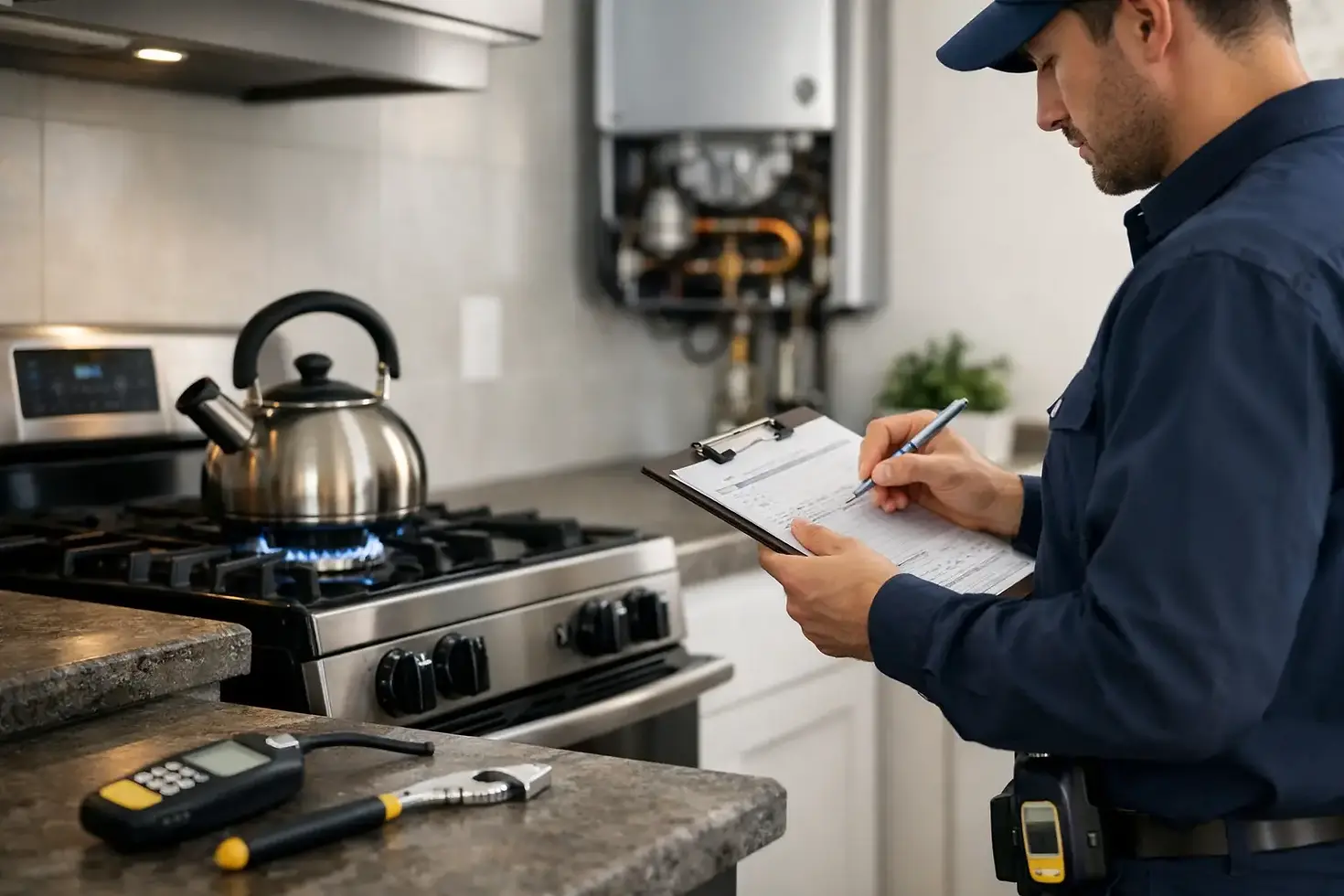
What an engineer checks during a gas safety inspection
A proper inspection is based on the appliances and installation at the property. The exact checks depend on what is fitted, its condition and how it is installed. A boiler inspection is different from checking a gas hob, for example.
The engineer will generally check that appliances are correctly installed, operating safely and suitable for continued use. This includes checking for signs of unsafe combustion, adequate ventilation, the condition and effectiveness of flues, and whether safety devices are working as intended.
They will also assess whether an appliance is showing signs of poor combustion or producing dangerous levels of carbon monoxide. Gas soundness and connection points may be checked where required, particularly if there are concerns about leaks, alterations or damaged pipework.
A visual inspection alone is not enough. Engineers use the correct test equipment and apply the relevant safety standards to the appliance type. This is why landlords should always confirm that the person carrying out the work is Gas Safe registered and qualified for the appliances being inspected.
What the record should show
Once the inspection is complete, the gas appliance safety record should clearly show the result for each relevant appliance and flue. If an item has passed, it will be recorded as safe at the time of inspection. If a fault is found, the report should explain the issue and the action taken.
An engineer may classify a fault as At Risk or Immediately Dangerous. An Immediately Dangerous appliance presents an immediate danger if used or connected to the gas supply. It should not remain in use. An At Risk appliance has a fault that could become dangerous and also requires prompt attention.
Where an appliance is unsafe, the engineer may isolate it from the gas supply with permission. This can be inconvenient, particularly when it affects heating or hot water, but leaving a dangerous appliance in operation is not an acceptable option. Repairs, replacement parts or a new appliance may be needed before the item can be used again.
A safety check is not the same as a boiler service
Landlords often assume an annual gas safety inspection automatically includes a full boiler service. It does not necessarily do so. A gas safety check confirms safety and legal compliance, while a service is a more detailed maintenance visit focused on condition, performance and helping prevent breakdowns.
Combining the two can be practical, especially for a rental property with a boiler approaching its annual service date. It can reduce appointments and help keep the heating system in better condition. However, the scope and price should be clear before the visit, as a safety check and service are separate tasks.
The same principle applies to gas hobs and cookers. An appliance may meet the immediate safety requirements but still have worn components, poor burner performance or cleaning issues that should be addressed to improve reliability.
Landlord deadlines and record keeping
A landlord gas safety check must be completed every 12 months. You can arrange a renewal up to 28 days before the current record expires without changing the existing annual deadline. This gives landlords useful flexibility when organising access around occupied properties and busy changeover periods.
New tenants must receive a copy of the current record before they move in. Existing tenants must receive the new record within 28 days of the check. Landlords must keep gas safety records for at least two years.
Leaving the booking until the final day creates avoidable pressure. Tenants may be unavailable, an appliance may fail inspection, or repairs may be required before a compliant record can be issued. Booking early gives time to resolve problems without holding up a move-in date or leaving a property without heating.
Preparing for the appointment
Make sure the engineer can access every gas appliance, meter, boiler cupboard, flue inspection point and relevant room. Tell tenants in advance when access is needed, particularly if the boiler is in a bedroom, locked cupboard or loft space.
If there have been warning signs, mention them before the visit. These include a yellow or lazy flame, soot or staining around an appliance, repeated boiler lockouts, unusual smells, headaches that improve when leaving the property, or a carbon monoxide alarm sounding. Do not wait for the annual inspection if you suspect a gas leak or carbon monoxide issue. Turn off the gas supply if it is safe to do so, ventilate the property, avoid electrical switches and seek urgent professional help.
For landlords in Bournemouth, Poole and Christchurch, arranging the annual check before a tenancy renewal or property handover makes compliance easier. A clear appointment, proper inspection and prompt record mean one less issue to manage when the property is busy.
If your current record is close to expiry, book the check early. It protects your tenants, keeps your paperwork in order and gives you time to deal with any fault properly rather than under pressure.


Comments